Super Rope: Hero Flying
- 4.6
- Rating
- 10.00M
- Installs
- Free
- Price
 Analysis by App-foxy
I spent time with Super Rope: Hero Flying to understand whether its central idea—moving through the air like a rope-swinging hero—has enough depth to hold attention beyond the first few minutes. My impression is that it succeeds best as a quick, accessible action game rather than as a large superhero adventure. The appeal is immediate: you want to launch, swing, adjust your direction, and see how smoothly you can keep moving.
That focus gives the game a clear identity. It does not ask me to learn a complicated control system before having fun. Instead, it puts the flying fantasy first and lets the movement itself carry the experience. If you enjoy short sessions built around timing and momentum, this is an easy game to understand. If you are looking for a detailed story, deep character development, or a broad role-playing system, I would set expectations differently from the start.
Staga presents it as a free action game for a wide audience, with an Everyone age rating and support for Android devices running version 7.0 or later. It was released on March 4, 2025, and the current version is 2.3.8. The game has already passed ten million installs and holds a 4.5 average from around 5.8 thousand ratings, which suggests that the simple flying concept has found a sizable audience.
You May Also Like

 Blood Strike: 2.5 Anniversary
Blood Strike’s Loadouts Turn Every Drop Into a Tactical Gamble
A close look at Blood Strike’s custom loadouts: how fast access to signature weapons reshapes its battle royale rhythm, rewards preparation, and narrows the gap between fights.

 Pandora - Music & Podcasts
Pandora’s Music Is Easy to Start, but Harder to Recover
Pandora’s strength is its low-effort path from a seed to a station. Its weak spot is how much confidence it asks you to place in connection, setup, and quiet recovery.

 8 Ball Pool
 Is Built on Rivalries, Rematches, and Routine
A close look at the rivalries, rematches, shared routines, and unanswered safety questions that turn a quick pool match into a persistent mobile community.

 Samsung Music
’s Quiet Strength Is Playing What You Already Own
Its reach comes less from spectacle than from dependable access to a personal library. That simplicity is both the app’s strongest retention engine and its ceiling.

 AccuWeather: Weather Radar
AccuWeather Review: A Quick, Clear Forecast for Everyday Decisions
For everyday plans, the best forecast is the one you can understand quickly. AccuWeather makes rain timing, radar, and local conditions easy to act on, with a few trade-offs.

 Hill Climb Racing
Why Hill Climb Racing Still Turns Crashes Into One More Run
A tiny car, a bumpy hill and one more upgrade: Hill Climb Racing keeps resurfacing because its simple chaos makes every near-miss feel personal.
More From Our News Desk



The rope-swinging ability is the whole reason to play
The most important capability here is not a side feature; it is the way the hero travels. The rope changes ordinary movement into a sequence of decisions. I am not simply walking toward a target or tapping an attack button. I am thinking about where to attach the rope, when to release it, and how to preserve enough motion to reach the next useful position.
That difference matters because movement becomes the challenge. A successful swing feels earned through timing rather than through a long chain of menus or equipment upgrades. When the rhythm works, the hero seems to flow from one point to another. When the timing is poor, the same system can feel awkward, and a small mistake can interrupt the run. The game’s strongest moments come from that narrow space between control and momentum.
I found the ability most enjoyable when I stopped trying to rush every action. The natural temptation is to tap quickly and expect the hero to fly exactly where I want. A better approach is to treat each rope connection as part of a route. Look ahead, choose a useful anchor, allow the swing to build, and release with a purpose. This makes the game feel less like random movement and more like a compact timing exercise.
The real skill is controlling momentum, not merely attaching the rope. That is an important distinction for new players. If you focus only on reaching the next point, you may arrive with no useful speed for what follows. If you think about the next two movements instead of just the current one, the flying becomes more consistent. This is one of the few ways to make the simple premise feel more rewarding over time.
What the controls feel like during a normal session
In practice, the game is easy to pick up because its main action is visually obvious. I can understand what I am trying to do almost immediately: connect the hero to a point, swing through the space, and continue moving. That makes it suitable for short breaks, especially when I want something more active than a puzzle but less demanding than a long competitive match.
The challenge comes from precision. A control that feels responsive can still expose mistakes quickly, because the hero’s position and speed change while the rope is active. I had to learn not to overcorrect. Repeated taps or hurried changes can turn a promising swing into a messy one. The game rewards calm input, and that gives it more substance than the short store summary might suggest.
There is also a useful mental split between planning and reaction. Planning means identifying a safe or productive direction before committing. Reaction means responding when the hero is already moving and the timing window is closing. Players who enjoy both parts will probably find the central loop satisfying. Players who prefer direct controls with immediate, predictable results may find the same movement system frustrating.
For that reason, I recommend starting slowly rather than judging the game after a few failed attempts. The first sessions can feel less like heroic flight and more like learning the limits of a pendulum. Once I began releasing at the right moment instead of holding on too long, the experience became much more readable. The game still has a light, casual feel, but it rewards attention.
A practical way to improve without turning it into homework
My most useful adjustment was to divide each attempt into three questions: where should I attach, how much swing do I need, and where do I want to be after release? This simple routine prevents frantic input. It also helps explain failures. If the hero never gained enough speed, the issue was probably the swing. If the hero moved too far sideways, the attachment choice or release direction needed work.
I also found it helpful to watch the hero’s position rather than staring only at the rope. The rope tells me what is connected, but the body’s movement tells me whether the current action is actually helping. That small change in attention made the controls feel less mysterious. It is a practical tip for anyone who feels that the hero is drifting unpredictably.
Another useful habit is to treat a failed attempt as information instead of immediately repeating the same input. If a particular release sends the hero short, releasing earlier may help. If the hero overshoots, holding on longer is not automatically the solution; the better answer may be choosing a different attachment point. This is where the game has a modest but real learning curve.
I would not describe the controls as a substitute for a full physics simulator. The experience is designed for accessibility, not technical realism. That is a strength when I want a quick game, but it also limits how much complexity the movement can support. After the initial discovery period, the main question becomes whether I enjoy refining timing within this focused system.
The best everyday scenario is a short, focused break
The clearest use case for me is a ten-minute break when I want something I can start immediately and understand without preparation. Imagine waiting for an appointment or taking a pause between tasks. A game based on quick flying attempts fits that moment well because the central action is clear, and I do not need to remember a large story or manage a complicated build before playing.
It also works for players who like the fantasy of superhero movement more than traditional combat. The satisfaction comes from moving through space with style and control. If your favorite part of action games is crossing the environment quickly, avoiding awkward stops, and finding a clean route, this is more relevant to you than a conventional beat-'em-up or a slow exploration game.
Parents may also appreciate the broad age positioning. The Everyone rating makes the game easier to consider for a general family audience, although I would still let younger players try the controls themselves to see whether the timing feels comfortable. The concept is simple enough to explain, and the action does not require a long tutorial speech to understand.
For a commuter or casual player, the main advantage is low commitment. I can play when I have a little time, enjoy the movement, and stop without feeling that I have abandoned a complicated campaign. That is a meaningful strength compared with larger action games that demand longer sessions or constant attention to multiple systems.
However, this same quality can become a weakness. If I am looking for a game that gives me a strong reason to return for a long evening, the rope mechanic may not be enough by itself. The experience depends heavily on how much I enjoy repeating movement challenges and improving my timing. Players who need a rich narrative or a large variety of activities may run out of novelty sooner.
How it compares with more familiar action games
Compared with a standard mobile action game built around direct attacks, Super Rope: Hero Flying puts movement ahead of combat. That makes it feel lighter and more focused. I spend more attention on trajectory and timing than on choosing weapons, managing abilities, or studying enemy patterns. If you want immediate physical control, that is a refreshing change.
Compared with endless runners, it offers a more deliberate form of travel. A runner usually emphasizes continuous forward motion and rapid reactions. Here, the rope gives me more influence over how the hero moves, but it also makes each decision feel more exposed. I cannot rely only on reflexes; I need to consider the arc and the next position.
Compared with open-world superhero games, this is much more compact. There is no reason to approach it expecting a large city to explore or a cinematic hero story. Its value is concentrated in the flying interaction. I would choose this game when I want the feeling of swinging through the air without committing to a huge package of missions and systems.
That comparison also explains who should skip it. If your ideal action game includes deep combat, character customization, competitive rankings, or a long campaign, another title in the category will probably suit you better. Super Rope: Hero Flying is strongest when judged as a focused movement game, not when measured against the feature list of a full-scale console-style adventure.
The tradeoffs behind the simple design
The free price makes it easy to try, and that matters for a game whose appeal depends so much on personal control preference. I can install it without treating the decision as a major commitment. The broad device compatibility also helps, since Android users on version 7.0 or newer can consider it without needing a recent operating system.
Still, free access does not automatically mean unlimited variety. The game’s design is built around one recognizable fantasy, so repetition is the main tradeoff. I enjoyed refining my movement, but I could also see why some players would want more layers around it. The rope mechanic has to remain satisfying on its own because it is the feature doing most of the work.
The control style creates another tradeoff between accessibility and precision. It is approachable enough for a first attempt, yet mistakes can feel abrupt when the timing is off. That combination is not necessarily a flaw, but it means the game may divide players. Someone who enjoys learning a physical rhythm will see room for improvement; someone who wants every tap to produce a perfectly predictable result may become impatient.
There is also a difference between visual fantasy and mechanical depth. Flying like a hero sounds expansive, but the actual experience is more focused and repeatable. I would not confuse the sense of motion with a large simulation. The game gives me a compact interpretation of heroic travel, and its success depends on whether that interpretation feels good in my hands.
One practical limitation is that the game is not the best choice when I want a quiet, passive experience. Even though the premise is simple, good results require attention to timing. It is easy to play casually, but playing well is more active than the bright superhero theme might suggest. That makes it a poor fit for multitasking or for moments when I cannot look at the screen consistently.
Questions I would consider before installing
If you are wondering whether it is genuinely free to start, yes: the game is listed as free. That makes it suitable for trying the core movement without paying upfront. I would still approach it as a casual action title rather than assuming that free access guarantees the breadth of a premium game.
If you are unsure whether an older Android phone can run it, the stated minimum is Android 7.0. That is a relatively broad starting point, though actual comfort can still depend on the device and how smoothly it handles the game. The safest expectation is that compatibility makes installation possible, while the feel of the controls determines whether you enjoy playing.
If you want to know whether it is appropriate for younger players, its content rating is Everyone. The more important question is control tolerance: a child may understand the hero concept quickly but still need time to learn the timing. I would treat it as an accessible game to try together rather than assuming every player will master the movement immediately.
If you are choosing between this and a larger superhero game, I would decide based on session length and priorities. Pick this one for direct rope-based movement and quick action. Choose the larger alternative if story, exploration, combat variety, or customization matters more than the sensation of swinging.
Who gets the most from this focused flying game
The best audience is made up of players who enjoy mastering one clear mechanic. You will probably get the most from it if the idea of improving a route, timing a release, and making a smoother flight sounds satisfying. The game does not need a complicated explanation to become interesting; its depth comes from how consistently you can turn simple inputs into controlled movement.
It is also a good match for people who prefer short mobile sessions. I can imagine using it between larger tasks, during a brief wait, or whenever I want a quick action game without a long setup. The free entry point and broad age rating make that recommendation easier, especially for someone who wants to experiment before committing to a more demanding title.
I would be more cautious recommending it to players who need constant novelty. If you lose interest when a game centers on one repeated action, the rope system may not hold you for long. The same applies to players who prefer strategy menus, deep progression, or story-driven goals. Those are not the reasons to choose this game.
Staga has kept the idea easy to grasp, and the result is approachable without being completely mindless. My advice is to give the movement a fair trial: do not judge it only by the first awkward swings, but also do not expect it to transform into a full superhero epic. Its value is in the compact interaction between attachment, momentum, and release.
With a 4.5 average and more than ten million installs, it has clearly attracted many players, while its current version, 2.3.8, shows that the game is still being presented in an updated form. Those figures are useful context, but my recommendation rests more on the actual fit. Choose Super Rope: Hero Flying for a quick, timing-focused flying experience, not for a complete superhero world. For the right player, that narrow focus is exactly what makes it enjoyable.
FAQs for Super Rope: Hero Flying
01What is Super Rope: Hero Flying about?
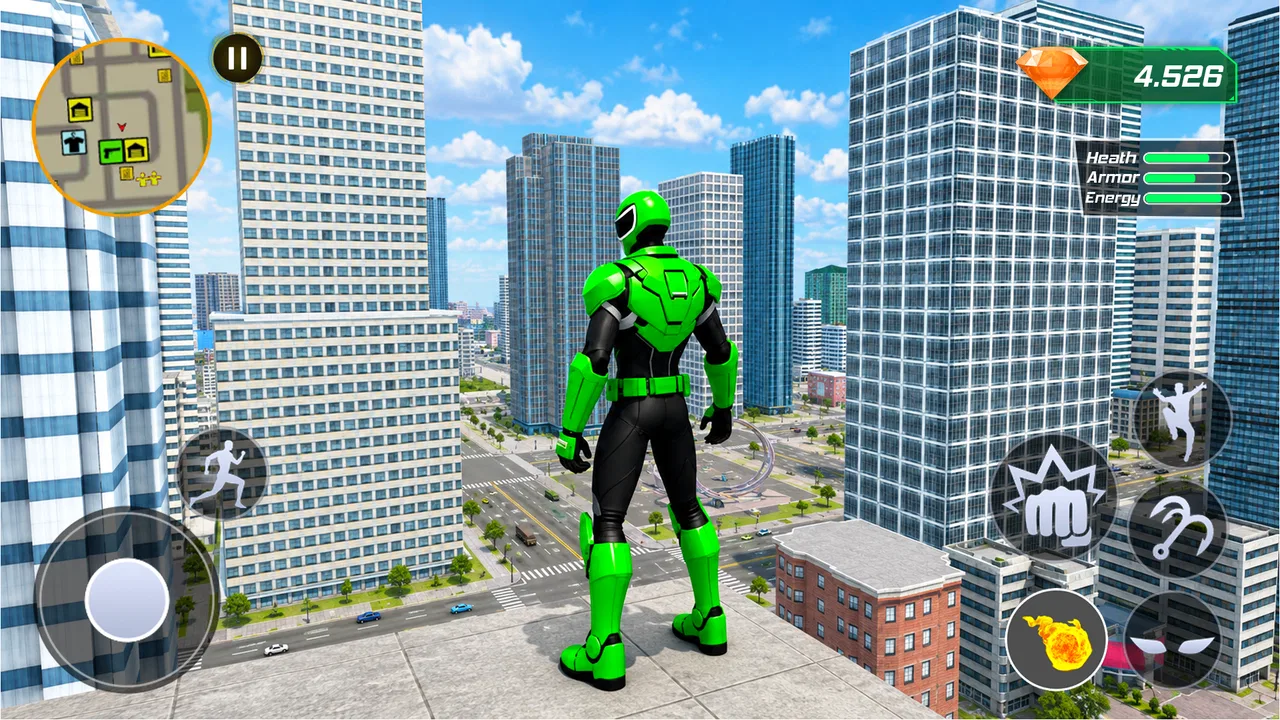
Super Rope: Hero Flying is an action-packed game that lets you experience the thrill of being a superhero with incredible rope-swinging abilities. Set in a vibrant cityscape, you can explore the environment, complete missions, and battle enemies using your unique powers. The game combines open-world exploration with engaging combat mechanics.
02Is Super Rope: Hero Flying free to play?
Yes, Super Rope: Hero Flying is free to download and play. However, it offers in-app purchases that can enhance gameplay or unlock additional features. These purchases are optional, and you can enjoy the game without spending money, though some players may find the extra content appealing for a more enriched experience.
03What devices are compatible with Super Rope: Hero Flying?
Super Rope: Hero Flying is available on both Android and iOS platforms. It requires Android version 5.0 or later and iOS 10.0 or later. Ensure your device meets these requirements to enjoy smooth gameplay. The game is optimized for both smartphones and tablets, providing a seamless experience across different devices.
04Are there any ads in Super Rope: Hero Flying?
Yes, Super Rope: Hero Flying contains ads. These ads help support the developers and keep the game free for all players. While most ads are non-intrusive, some players may find them a bit disruptive. If you prefer an ad-free experience, consider using in-app purchases to remove ads altogether.
05How do I control the character in Super Rope: Hero Flying?
In Super Rope: Hero Flying, the controls are intuitive and user-friendly. Use the on-screen joystick to navigate the city and swipe gestures to perform rope swings and attacks. The game also provides tutorials to help new players master the controls quickly. Experimenting with different moves can enhance your gameplay experience.
Pros
- Engaging open-world experience.
- Smooth and responsive controls.
- Unique superhero abilities.
- Vibrant and detailed graphics.
- Regular updates enhance gameplay.
Cons
- Occasional in-app purchase prompts.
- Ad interruptions can be frequent.
- Limited customization options.
- Requires stable internet connection.
- Some missions feel repetitive.

Super Rope: Hero Flying
Gallery